Showing posts with label fine art gourds. Show all posts

Tuesday, March 13, 2012

Sculptures Completed At Celebration of Fine Art

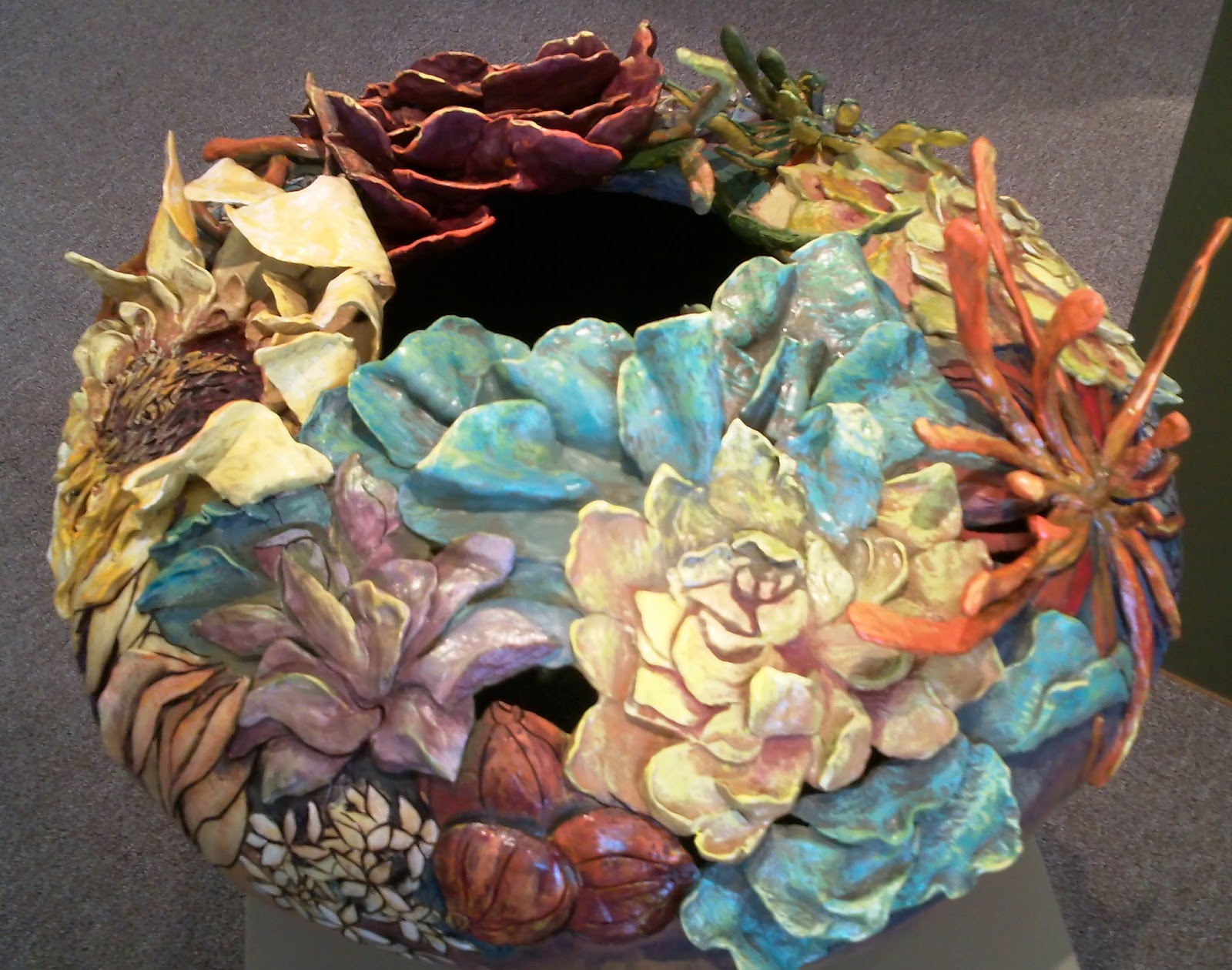
Completed at the show and on the floor now!  Only two weeks left in this year's show, so come and see this work first hand.  We'd love to chat with you. Don't forget that the show has moved to the corner of Hayden and the 101 loop, one mile east of the old location on Scottsdale Rd.  Easiest way to get there is from the 101 - exit 35.  Both pieces on mounted on revolving stands and so are meant to be viewed from all angles and sides.

Behind the Garden Shed
36" w x 32" h


Three Varieties
approx 10" w at  center point,
22" spread at top,  30" h
www.celebrateart.com
www.whitneypeckman.com

Sunday, February 12, 2012

Gourd Translations

The Celebration of Fine Art gets so many visitors from all over the world that I often find myself at a real loss when describing the material from which I do my sculptural vessels.  So, here is "gourd" in a wealth of languages!  And some pictures of fine art gourd sculptures I now have at the Celebration.

Full Bodied
Red Red Poppies


In A Poppy Garden


Translations of 'gourd'Kernerman English Multilingual Dictionary 

Sense 1: a type of large fruit, or the plant on which it grows.
 gourd in Afrikaans: komkommer, karkoer
 gourd in Arabic: يَقْطين، قَرع

 gourd in Bulgarian: кратуна
 gourd in Brazilian: cabaça

 gourd in Chinese: 葫芦
 gourd in Croatian: sušena tikva

 gourd in Czech: tykev
 gourd in Danish: græskar
 gourd in Dutch: pompoen
 gourd in Estonian: pudelkõrvits
 gourd in Finnish: kurkkukasvi

 gourd in Farsi: هر گیاهی از تیره کدو
 gourd in French: gourde
 gourd in German: der   
Flaschenkürbis
 gourd in Greek: (νερο)κολοκύθα

 gourd in Hebrew: דְלַעַת 

 gourd in Hindi: कद्दू के वर्ग की सब्जी
 gourd in Hungarian: (dísz)tök
 gourd in Icelandic: grasker
 gourd in Indonesian: labu

 gourd in Italian: (frutto delle cucurbitace
 gourd in Japanese: ひょうたん
 gourd in Korean: 박과(科) 열매의 총칭

 gourd in Latvian: (pudeļveida) ķirbis
 gourd in Lithuanian: moliūgas
 gourd in Malay: labu
 gourd in Norwegian: gresskar
 gourd in Pashto: اونورو شيانو په حيث كار ځ

 gourd in Persian: هر گیاهی از تیره کدو
 gourd in Polish: dynia

 gourd in Portuguese: cabaça
 gourd in Romanian: tigvă

 gourd in Russian: тыква бутылочная
 gourd in Serbian: tikva
 gourd in Slovak: tekvica

 gourd in Slovenian: buča
 gourd in Spanish: calabaza

 gourd in Swedish: pumpa
 gourd in Taiwanese: 葫蘆
 gourd in Thai: น้ำเต้า

 gourd in Turkish: su kabağı
 gourd in Ukrainian: гарбуз
 gourd in Urdu:ی پیٹھا، گھیا، لوک
 gourd in Vietnamese: quả bầu; quả bí

Images of 'gourd'Inappropriate image? 
                     

Friday, January 27, 2012

Collaboration of the Celebration Kind

Here's a little tale of a happy combination at the Celebration of Fine Art - I started working on a little gourd with a new technique of layering 10-15 glazes for a dimensional effect in a floral design with a little yellow bird included.  As I worked I was thinking of how to finish the raw gourd top...the design seemed so elegant that the raw edge clearly wasn't right.  I had found an interesting old Victorian brass back plate for a door knocker while I was in San Diego over Christmas.  Just the right size and fit!  But, what to do about the hole...now that seemed unfinished.  You know, these "simple little projects" sometimes get away from you!  So, I wandered down to see what my friends Donna Armstrong and Donna Bernstein thought.  We all mulled it over.  Came up with some great ideas, but the best was to ask Kevin Powers if he would blow a small stopper for it...and so, back to the other end of the tent, where Kevin was working away on his glass.  Gracious guy that he is, he said, sure, let's do it...and after the show closed last night, he blew the sweetest little stopper with a delicate yellow flower in the center, just the exact colors of the work I had done.  And here is the  glass blowing process and the finished piece!  Sweet! Sweet! Sweet!


Monday, January 16, 2012

Slideshow of Setting Up the CoFA 2012 show

Syed working on the light structure for our studios

Slideshow of setting up the 2012 CoFA show! Click on this link to see the process of setting up the Celebration of Fine Art studios for this 10 week long event and experience what the artists do to bring an amazing selection of work for you to peruse, wonder at, be dazzled by and to share with your friends.  It is a daunting task and takes almost 5 full days to complete - often on opening day we wouldn't want you to open any closets for fear of what might tumble out!  But by mid week we're all at work in our studios and ready to share what we do, how we do it, and what inspires us.  This is an exciting venue, really unique in the country, and at our new location at the intersection of the Loop 101 and Hayden Rd Exit, stunningly beautiful as the sun goes down casting those AZ  colors on the McDowell Mts.

This show is a big part of our lives, spending 3 full months with almost 100 other artists, and it is inspirational and energizing, so watch for regular posts about what Syed and I are doing, what our artist friends are working on, and occasional philosophical musings.

And now, it's back to work!

Wednesday, May 11, 2011

Website Update

Finally updated my website www.whitneypeckman.com, so hope you'll take a peek - time to build inventory after our great winter - so thanks everyone for your continued support of my work.

Saturday, May 7, 2011

Artists and Commissions

Note: This is a post I wrote for NWSalon.com and was originally published there in Mar 2011.  I am reprinting it here as a response to a Twitter stream.  Thanks . Whitney
For a variety of reasons, some artists dislike working on this basis, preferring instead to sell only what has already been completed.  Others of us enjoy the challenge and the conversation to balance and coordinate our ideas with that of our client.
Final touches
What contributes to getting a commission? (And here I am speaking only of private commissions, not public or corporate ones.)
Listening is the first and, I think, most critical.  We listen for that which impresses the viewer, because, after all, it has to be more than just a “that’s nice” reaction to our work to interest them in a specially made piece.  Each artist has a gut feeling about the strength of his own work.  Is it born out by the viewer?  Or, can you hear a potential problem – perhaps, “I love that piece, but not the colors” or “Beautiful colors! Too big, though.”  There are hesitations to listen for, and tones, and casual comments – “Hmmmmm” and “That would look great in your bathroom, Alice,” and “Good colors, but not so much for the bedroom, do you think, Honey?” or “Hmmmm, not quite."
So is a positive comment always a positive?  And is a negative one always a negative?  No, to both questions.
Loving someone’s work doesn’t automatically mean anything.  It is, however, an invitation to ask your own questions.  “What is it about the piece that you most like?”  (Appreciate that they may be in awe and inclined to burst out with “Everything!” but encourage them to be more specific.)  Now here is the place where sales books tell you to begin inquiring about their home and “qualifying” them.  I HATE this approach. I’m not a car salesman.  This person who is standing in your booth or studio or gallery is most likely responding to your work on an emotional level.  For me, that is the signal that we have a place where we might relate to one another. Instead of assessing her shoes and asking, “Do you collect original art?” I might ask if she gardens (because she is staring at my garden painting) or “Are you from here?  Are you watching for the hummingbirds to come back?” (because I have some in another piece).  Take a few moments to find what moves this person, because what moves her in her role as viewer, as potential client, is what may move you, motivate you, inspire you.  A piece of your self, your being, your soul can make a difference in a client’s life.  Learning a bit about who she is as an individual can open the door to the possibility of a long and successful artist/client relationship.  Finding spaces for relatedness connects both ourselves and our art to other human beings.  Relatedness never happens in isolation 
Similarly, “Nice colors, but it won’t work,” may sound negative, but in actuality is not at all.  Acknowledging their appreciation of your colors is the open door.  “Thanks – I’m glad you like my colors!  But what is it that won’t work?  I’m always interested in people’s difficult spaces.”  Your interest in their space is personal and caring.  I have had this conversation many times in my career.  Sometimes the resolution I see requires a different kind of artwork, and I am able to suggest artists who might be a better fit.  Often it is just an issue of position or shape or pattern – basic design principles of which they may not have a working knowledge.  It’s a great feeling to see their eyes light up when they see the possibility of one of my suggestions working for them.  And what better way to develop trust but to help in a generous manner without agenda.  If you don’t get the immediate sale, I guarantee that you will see the benefit down the line as they tell their friends all about you and your work.”
After you have developed the seeds of a relationship with your potential client, what comes next? 
Instead of announcing that you do a lot of commission work, why not suggest looking at their problem space together – maybe try a few pieces in the space to see what kinds of shapes/colors/sizes might work?  “Perhaps we’ll come up with some fresh ideas – then we can go from there.  I’d love to be part of the solution!”
Artists have good eyes.  That means if we use them, it is easy for us to take in a great deal of visual information, assimilate it, and generate many possibilities to solve spatial and design problems.  Are you approaching commission work with your eyes wide open, or are you just looking for a quick sale – no fuss, no muss?  It’s perfectly ok not to be interested or inspired by collaborating with the client.  If this is the case, just be clear about it within your own mind, be generous – give the client some artist’s names who might better be able to meet their needs.  Be clear about boundary lines –“I can incorporate this idea of yours, but not that.”  But, if you like this type of problem solving, then enter their home, eyes open to the myriad of details in their surroundings.  Why is the problem area a problem?  Listen to why they think it’s a problem.  Are they looking at your sculptures which are clearly not going to fit into the 4” deep niche?  Should they be considering a painting or shallow wall sculpture instead?  Can you see a place where they might be able to place your large sculpture?  Suggest it.  Perhaps you are a painter and they like garden paintings but have four broad-view garden paintings already in the room.  Suggest to them that perhaps they would like to consider a close up of the iris – one bloom in fine detail – to set off their wonderful collection of garden paintings.  Do you hate the other paintings?  Do not be insincere, but look at their home from their viewpoint.  After all, you are not the one living in the home.  They have paid you the complement of loving your work.  Respect their other choices.
Listening. Seeing the fun in problem solving. Respecting your audience.  Require 50% deposits and gurantee your work (they will be less anxious and, after thirty years of being an artist, I’ve never had to return anyone’s deposit).


Friday, March 18, 2011

Artists Working with Commissions

Final touches on Loretta's Poppies - a 2011 commissioned work


Our show in AZ, the Celebration of Fine Art, is coming to a close on Mar. 27.  Many of the artists are finishing up commission work to be delivered by the closing.  Others are just finalizing designs on to be completed during the year.

For a variety of reasons, some artists dislike working on this basis, preferring instead to sell only what has already been completed.  Others of us enjoy the challenge and the conversation to balance and coordinate our ideas with that of our client.

What contributes to getting a commission? (And here I am speaking only of private commissions, not public or corporate ones.)

Final touches
Listening is the first and, I think, most critical factor.  We listen for that which impresses the viewer, because, after all, it has to be more than just a “that’s nice” reaction to our work to interest them in a specially made piece.  Each artist has a gut feeling about the strength of his own work.  Is it born out by the viewer?  Or, can you hear a potential problem – perhaps, “I love that piece, but not the colors” or “Beautiful colors! Too big, though.”  There are hesitations to listen for, and tones, and casual comments – “Hmmmmm” and “That would look great in your bathroom, Alice,” and “Good colors, but not so much for the bedroom, do you think, Honey?” or “Hmmmm, not quite.”

So is a positive comment always a positive?  And is a negative one always a negative?  No, to both questions.

Loving someone’s work doesn’t automatically mean anything.  It is, however, an invitation to ask your own questions.  “What is it about the piece that you most like?”  (Appreciate that they may be in awe and inclined to burst out with “Everything!” but encourage them to be more specific.)  Now here is the place where sales books tell you to begin inquiring about their home and “qualifying” them.  I HATE this approach. I’m not a car salesman.  This person who is standing in your booth or studio or gallery is most likely responding to your work on an emotional level.  For me, that is the signal that we have a place where we might relate to one another. Instead of assessing her shoes and asking, “Do you collect original art?” I might ask if she gardens (because she is staring at my garden painting) or “Are you from here?  Are you watching for the hummingbirds to come back?” (because I have some in another piece).  

Take a few moments to find what moves this person, because what moves her in her role as viewer, as potential client, is what may move you, motivate you, inspire you.  A piece of your self, your being, your soul can make a difference in a client’s life.  Learning a bit about who she is as an individual can open the door to the possibility of a long and successful artist/client relationship.  Finding spaces for relatedness connects both ourselves and our art to other human beings.  Relatedness never happens in isolation

Similarly, “Nice colors, but it won’t work,” may sound negative, but in actuality is not at all.  Acknowledging their appreciation of your colors is the open door.  “Thanks – I’m glad you like my colors!  But what is it that won’t work?  I’m always interested in people’s difficult spaces.”  Your interest in their space is personal and caring.  I have had this conversation many times in my career.  Sometimes the resolution I see requires a different kind of artwork, and I am able to suggest artists who might be a better fit.  Often it is just an issue of position or shape or pattern – basic design principles of which they may not have a working knowledge.  It’s a great feeling to see their eyes light up when they see the possibility of one of my suggestions working for them.  And what better way to develop trust but to help in a generous manner without agenda.  If you don’t get the immediate sale, I guarantee that you will see the benefit down the line as they tell their friends all about you and your work.

After you have developed the seeds of a relationship with your potential client, what comes next? 

Instead of announcing that you do a lot of commission work, why not suggest looking at their problem space together – maybe try a few pieces in the space to see what kinds of shapes/colors/sizes might work?  “Perhaps we’ll come up with some fresh ideas – then we can go from there.  I’d love to be part of the solution!”

Artists have good eyes.  That means if we use them, it is easy for us to take in a great deal of visual information, assimilate it, and generate many possibilities to solve spatial and design problems.  Are you approaching commission work with your eyes wide open, or are you just looking for a quick sale – no fuss, no muss?  It’s perfectly ok not to be interested or inspired by collaborating with the client.  If this is the case, just be clear about it within your own mind, be generous – give the client some artist’s names who might better be able to meet their needs.  Be clear about boundary lines –“I can incorporate this idea of yours, but not that.”  

But, if you like this type of problem solving, then enter their home, eyes open to the myriad of details in their surroundings.  Why is the problem area a problem?  Listen to why they think it’s a problem.  Are they looking at your sculptures which are clearly not going to fit into the 4” deep niche?  Should they be considering a painting or shallow wall sculpture instead?  Can you see a place where they might be able to place your large sculpture?  Suggest it.  Perhaps you are a painter and they like garden paintings but have four broad-view garden paintings already in the room.  Suggest to them that perhaps they would like to consider a close up of the iris – one bloom in fine detail – to set off their wonderful collection of garden paintings.  Do you hate the other paintings?  Do not be insincere, but look at their home from their viewpoint.  After all, you are not the one living in the home.  They have paid you the compliment of loving your work.  Respect their other choices.

Listening. Seeing the fun in problem solving. Respecting your audience. That's my mix for getting commission work.  Require 50% deposits and gurantee your work (they will be less anxious and, after thirty years of being an artist, I’ve never had to return anyone’s deposit).


Saturday, January 22, 2011

Succulents & Sunflower

Saying goodbye to an art work that I worked hard on and which rose to the top of my expectations of the piece, is a wonderful feeling.  It's really a successful communication - a conversation between the artist and the viewer (and in this case, the buyer) in the form of the art - and that process is a sort of art in and of itself, if that makes sense.  It all feels like a completed full circle when the art finds its "person".  And so, here are three views of Succulents & Sunflower which met, and went home with, its person today.


And tomorrow I'll say hello to the beginnings of a new piece - Poppies in the Grass.....


Tuesday, January 18, 2011

Efflorescence and Inspiration from Poetry

"Efflorescence" Series is the name of this innovative new work from Syed.  Multi-layered glass panels inset in etched copper-clad boxes are pregnant with small shards, creating volume and depth of color which delicately shimmers, shifting color as you move across the piece.

Efflorescence - "a period of bloom", "a result of growth and development"- describes both the work and the artist's presence in his studio this year.
 The new "Autumn Sunset" Series is an extension (and may be seen at the Celebration of Fine Art along with the pieces shown here) of the original "Autumn" Series which he has reprised this year with some alterations in the etched copper portions.

Autumn for 2011


This year I had more time in my studio than I usually do.  This is always a gift from the Universe since I would greatly prefer to be there working than anywhere else on the planet (with children, being the only exception).  Coincidentally, I knew I would have a larger studio space at the Celebration.  I'm not sure I can quite describe the feeling of being lost in time and space that I get when lost in my work.  It is something of grace, I think.  The result is the major work this year - two large figurative pieces - and if you visit the show, I would be happy to tell you about them, as they have their own "stories", their "birth" and their "history".  

I Know Why the Caged Bird Sings/Madonna of the Sparrows

I Know Why the Caged Bird Sings/Letters from Burma

I had intended to introduce you today to Donna Armstrong's jewelry but I was not able to get her pictures yesterday....but check in tomorrow for simple elegance!

All text and images on this post copywrited 2011 Whitney Peckman


Sunday, January 16, 2011

The Best Laid Plans

My good intentions of posting every day ran right up against the world's worst cold!  I'm upright, finally, so here is yesterday's (and Opening Day's) post - a bit late but with pics.

Here is an overview of the NW Salon's area of the Celebration of Fine Art - starting with Donna Bernstein from Idaho and in her 2nd year at CoFA and in the NW Salon.  We love Donna's zen approach to equine art - very clean and powerful, capturing the spirit of movement and grace.


And this is her husband, Lex, who built her exquisite studio look.  Lex is always ready to lend any of us a hand - maintaining his good humor throughout (not an easy task surrounded by a bunch of perfectionist and opinionated artists) - and, if you want to talk soccer - Lex is your guy.

Directly next to Donna, and always well behaved, is Emma (that would be Emma the Dog).  Deb, who is our tech woman extraordinaire and wife of Ken Newman, a most remarkable sculptor who works primarily in wood and bronze, creating important pieces of commentary on nature and man.


Our newest artist to join the NW Salon, Steve Taylor, is in his 2nd year at CoFA and we are so glad to have him in our "neighborhood" - not only does Steve paint sensitive portraiture, he and his wife, Janelle, also make the best chicken soup on the planet - I know this personally because they came to my rescue with their remedy for the cold that laid me low for a couple of days (thanks!!).


Michael Jones, our steel sculptor and encylopedia of Native American symbology, has made both the inside and outside of the tent into a studio replete with gates, totems, and wall pieces.  He and his wife and "red apron lady" (our intrepid sales force at CoFA) Karen, live in Montana in an historic cabin in the mountains.   


So, there you have a taste of 2011 Celebration of Fine Art, and tomorrow I'll post elegant jewelry with very special cut stones, by Donna Armstrong, as well as Syed's and my studio space and some of our newest work.  Hope you'll continue along this journey and forward our link, too!


Saturday, January 15, 2011

Just the Beginning...

Good Morning Everyone, and a gorgeous morning it is here in Scottsdale, AZ!  The Celebration of Fine Art opened its doors last night for the opening night party and, though all the artists were breathing hard from the four days of fourteen hours constructing their studios and getting their work hung, the guests seemed only to marvel at the result (and enjoy the delectable offerings of Cafe Laredo).  Seeing old friends/clients who are always interested to see each artist's new work is food for the artists, and the appreciation feels like a real pat on the back for the efforts we make.

I hope to do something a bit different this year with my blog, posting each day about what's happening at the show, but particularly to acquaint you with our artists.  This is my fourteenth year at the show and I have seen so much remarkable work that I wish I had told more people about - now I have this great vehicle to do so.

For now, I'm off to our first official day and to shoot some pics for an overview to share with you tonight!

Monday, December 20, 2010

Celebration of Fine Art - Winner - 2010 Sterling Awards - Micro Business

We are so proud to be a part of this wonderful group. Susan and Jake Potje work all year long to make this event world class and really unique in the world of art shows. If you're in the Scottsdale, AZ area this winter, come visit us - I guarantee you won't be disappointed!

Saturday, November 27, 2010

From Start to Finish

Several weeks ago I posted an "in progress" group of pictures on my FB page.  I did finish the piece and here is the chronicle of the project - from start to finish.  It's a long process, doing a sculpted gourd using the natural direction of what nature gives me.  There isn't much sense in making drawings on paper because your plans will invariably go awry and your paper drawings will have been wasted.  I believe one has to "see" what the gourd wants to be, then help it become.


This tall snake gourd bent fairly gracefully in one direction,with a nice gentle swelling at the bottom.  The iris hiding there needed to be set free to blow in the garden breezes, leaves wanted to arch and droop as landing places for dragonflies and butterflies.  

After drawing the images onto the gourd and burning the line work in, the engineering begins - after all, when you cut a leaf or bloom from the center of the gourd, what will hold the remaining top to the bottom?  Leaves and stems must be rebuilt behind the flower which wants to lean outward.  After soaking the "free" parts of the design (blooms and leaves), the gourd walls are soaked in warm water and gradually bent, holding their positions with strings tied to weights or to the table, till the piece is completely dry.  If the parts are very narrow or the stem is all that holds the large bloom, support must be built onto the backside of the gourd wall.  But, careful, don't build so much support in that you can't reach the inside of the design where a butterfly might be resting.  The contraption in the pictures holds the gourd for me in any one of many positions.  I used to have to do the holding in my lap - very precarious!  All of the cut edges and the sculpture material added to make the design more 3-dimensional must be sanded, hence the mask.  The sander is loud - headphones help.  Sander makes talc-fine dust - so I hold the vacuum in my left hand while sanding with my right.  It's definitely a balancing act!

The painting is done in stages - basic colors applied in the beginning so that I don't mistake positive image for negative space.  Lots of layers of transparent acrylics build the nuanced color in each leaf and bloom.  Often something may start out life as magenta and end up as yellow!


Here are several views of the finished piece.  I miss gardening, but I love making one that lasts forever!  I'll be bringing this one to the Celebration of Fine Art, Scottsdale, opening Jan. 15.  Hope you'll get to see it!