Showing posts with label whitney peckman. Show all posts

Tuesday, June 26, 2012

Giving A Hand To A Friend

Meet my friend, Pam Creamer.  The picture is not the "real" Pam.  It's Pam With Lyme's Disease.  The "real" Pam is a talented painter, lover of animals, vivacious, energetic, loving, generous, independent, gracious, FUN, loyal....and....painfully ill with Lyme's Disease.  She has fought it for years, handling it on her own (with her partner, Anita) until all of their income and savings, including their business, is gone.  But here's the thing...she has begun a series of IV treatments in NYC because her friends have opened a website  to help raise funds for this staggeringly expensive treatment.  There have been so many, many donations and she is moving through the treatment protocol like the champion she is - it is very painful and debilitating, but it is working!  This is an ugly disease that takes a horrible tole on the body, not to mention the mind and the spirit!  But Pam is a fighter!  We believe she will conquer this and be able to paint again - and painting is how she has always made her living and paid her bills.

The thing is, and why you are seeing this on my blog, is that we have stalled out on the donations, and we have a little ways more to go to finish the treatments.  So, I am asking all of you reading this, all of you who have loved my work, supported me with your purchases, taken classes from me, been inspired by my work or my words, to please show that today by clicking Pam's picture, and making a donation to this wonderful team effort to get Pam well.  I know we all get asked all the time to donate, donate, donate.  But, if you will make a donation of $10 to Pam, I will send you a packet of greeting cards with pictures of my gourd sculptures as a huge thank you for joining our team (that's a $20 value for your donation of $10 - not a bad deal).  Just leave a comment here on my post or email me through my website and I will get the cards in the mail to you.

Think of this as paying it forward, of being an angel, of sending some love like a pebble thrown in the pond - making ripples that go on forever.

Thanks for your help!


Tuesday, January 3, 2012

Gorgeous Day At the Gourd Farm


Belying the stress prior to beginning the 2012 Celebration of Fine Art, I took December 31, a beautiful sunny day in San Diego County, and went to the Welburn Gourd Farm in Fallbrook, CA for an end of the year sale.  Sun shown through the live oaks, gourds were abundant (but none of the zucca that I went for), and it was blissfully quiet with only the singing of the birds.  And now, back to work!  Set up begins this coming Monday!

Tuesday, June 14, 2011

A Week of CreAtive Sparx in McCall, ID This Summer!

We are all so excited to be participating in the first summer of art events at the brand new McCall Art & Commerce Center in McCall, ID!  

Classes, events, exhibits and open studio time - something for everyone!

Don't miss the Art & Wine Pairing because it's a  delectable, delightful and delicious way to tickle your tongue and your eye!

The CreAtive Sparx 20/20 Vision will let you peek into the hearts, minds and souls of some artists in a stimulating and unusual way!

Visit the exhibit in the Gallery and see sculptures, paintings, glass, pottery, jewelry...and maybe even some surprises!

Join us for this inaugural event at MACC (and if you are a member, don't forget to ask for the discount on the class fees).

Sunday, May 1, 2011

The $12 Million Stuffed Shark

Oh, the grim reality exposed in The $12 Million Stuffed Shark: The Curious Economics of Contemporary Art by Don Thompson! 

Are you an artist? A collector? A lover of art? Or do you just like an occasional expose?  If you are interested in how the contemporary art market works, this is the book for you. 

A word of caution – if you are an artist with aspirations of fame and fortune this book might 1) depress you, 2) discourage you, 3)stimulate your more cynical side, 4) completely alter your style, technique, raison d’etre, 5) save you tens of thousands on art education. 

On the other  hand, if you are, like me, someone who has made a modest living for a few decades on art, this may be 1) an incredibly refreshing dose of truth, (heretofore hidden in the private conversations of fellow artists) made public, and thereby validating many of our opinions previously referred to as “sour grapes”, 2) an opportunity to thank those who have collected your work out of love for what you do, 3) a chance to reconsider just why you do what you do, and perhaps to rekindle your own passion, because, after reading this book you may re-evaluate “value”.

Monday, April 11, 2011

Assessing Value: More Than “I Know What I Like”

In my post “Pricing Artwork: Thinking, Making, Marketing + Vision.” I addressed value and pricing from the artist’s perspective.  Today I’d like to approach value and price from the collector’s perspective and talk about Intention, the Educated Buyer, Experience & Knowledge, and Tradition vs. Trendy.

To begin, let’s distinguish Intention. Are you someone wishing to purchase a casual piece of art, perhaps something to brighten the breakfast area or children’s bedroom, or are you someone looking for a piece that you expect to own for a long time and place in a main living area?  Perhaps you are both. 

Unless we are buying solely for investment purposes, most of us buy art because we love the piece or the final look of our space when it is in place. Rarely does one have the luxury of not considering their budget, so Intention, is something to be intentionally clear about.

If you are going to buy a casual piece and you know your budget, you may easily find just what you want in the giclee of a fine original that would otherwise be too expensive for the end use. Perhaps you would find a good choice of an original piece at a student show (where the prices may reflect promise but lack of experience & skill), or at a weekend street show (where there is usually a wide range of price and quality available). There are many retail stores selling inexpensive prints framed and ready to hang.  Of these sources, only in the choice of student work is there the possibility of an increase in value as time goes on, but it is very uncertain at best. 

If, on the other hand, you are looking to make a more serious investment in art (and here I am not speaking about the upper echelon of collector who may be buying Famous Dead Men art, but of the person who loves art, wants to buy work that has lasting value, is well crafted and which he/she feels is good value for the money.  If you are this person, there may be some homework to do before you decide on a purchase.  Homework? For art, you ask?  Well, would you run out and buy a car or washer, a computer or flat screen without doing your homework first?  So, yes, there is homework if you want to be a confident and educated buyer.

Years ago, traveling in Italy, I fell head over heels in love with olive oil.  Returning home, I found myself disappointed in the olive oil I would buy in the supermarkets.  It just never tasted the same.  Then, there were not the myriad choices, only two or three brands and not the interest in olive oil as a health food as there is now.  My disappointed palette adjusted.  It wasn’t until a good friend gave me some olive oil she had brought from her mother’s village in Calabria that I remembered the glorious taste of Italy.  My friend began to educate me on the differences in olive oil.  Like the distinctions in fine wines, an olive oil can make or break a salad of fresh spring greens or crusty rustico bread.  It is the same with art. 

It doesn’t matter if you are choosing an oil painting in the traditional style, a contemporary abstract, a mixed media assemblage, mono-print or serigraph, ink drawing or photography, glasswork, bronze, wood, or clay sculpture.  What does matter is how much you know about the medium you want to purchase, and what determines the value, both in the marketplace and by your own personal estimation.  Without having a clear idea of how value is assessed in the marketplace, how can you know if you are paying a fair price?  And how can you feel good about the price you pay if you don’t know to what you, personally, assign value?

A word about market value: schizophrenic.  Are you in New York?  Salisbury, NC?  Boise, ID? Santa Fe? Minneapolis or Detroit, Paris, Hong Kong or Killeen, TX? Or are you on the internet, Craig’s List, Sotheby’s auction or your local flea market?  If you are buying original art, not commercial reproductions or work produced in mass for a commercial market such as many quite large “cottage industries” produce, you would be well advised to understand that where you are buying the work can be almost as important as what you buy.  Are you buying directly from the artist or through a gallery? And what is the relationship between the artist and the gallery?  Does the artist undercut their galleries? Have you seen the artist making deals with other buyers or is he/she firm and consistent with pricing?  Does the artist or the gallery have sales where the prices are slashed? Does the gallery have an open relationship with their artists such as would enable you to meet the artist or does the gallery want to keep you and the artist as far apart as possible?  Do you think your conversations with the artist or the gallery about pricing are straightforward or manipulative, suggestive, or uncomfortable?  These are subjective questions, but I believe they are questions worth asking yourself as you shop for art.  You may be a person who is comfortable with dickering and dealing.  You may not be.  Either is ok.  It’s only important that you understand who you are and what you expect, accept, or refuse in terms of making purchases.

Other more obvious factors of which you want to be aware are high pressure sales techniques, half-truths, exaggerations and outright attempts to disguise or mislead the buyer.  These things seem ubiquitous in our consumer culture.  The pitfalls can be avoided with a little time doing your homework.

Let’s take a look at what makes an educated buyer in regards to art.  I am assuming you don’t want to be taken advantage of.  I certainly don’t!  So, if you know, for example, that you will be looking for a painting for your home, perhaps learning about materials and techniques would be a good place to start. 

Experience and knowledge will cultivate a discerning eye, making you a wiser collector. What is, in 2011, the intrinsic value of oil versus watercolor or acrylic?  In certain parts of the country one sees more of one than the other.  Does that availability have anything to do with the tradition of the area, i.e. traditional east coast and southern towns value oil most?  I see more acrylic used in Chicago, LA and Florida.  Is it because there seems to be more contemporary and abstract work shown in galleries there? Have you been told that it is more difficult to paint in one medium than the other?  I have often been told that of watercolor.  There are so many factors to consider in assessing skill that I find it hard to believe one type of paint should affect the value.  Perhaps then, it’s time for us to find out what other things we should look for.  Drawing ability, composition, color development, brush or palette strokes, and certainly expression are some of these.  Does the work look stiff, is the composition awkward but the color luscious?  Is the draftsmanship of the body graceful but the expression on the face stiff and unnatural?  Are one or two of the artist’s works quite wonderful but the remaining six only mediocre? Lots of questions often lead to more questions and the more questions you ask yourself, the greater the opportunity for you to learn what makes an educated buyer. 

Now that you have decided to better educate yourself about techniques, artists, galleries and materials you can begin to refine your choices of what to actually purchase.  Hopefully you have found a reputable gallery with a sales staff trained in techniques and styles so that when you question a work, you will get an honest answer about the difference, for example, between traditionally done frescos and work which is fresco-like; between a “print” that is a limited edition stone-ground litho and a giclee print of a painting; between gas fired pottery and wood fired pottery; between encaustic paintings and paintings with an encaustic finish.

Learning the why of all these distinctions is what will help you assign value to work.  The distinctions will have certain value in the marketplace.  They may also have a lesser or greater value for you personally.  For example, many years ago I wove a type of tapestry work.  There are traditionally woven tapestries done in the Aubusson or Gobelin style and there are contemporary weaving styles such as the Theo Moorman technique which can result in a painterly finished piece similar in some ways to traditional work.  If you are a textile traditionalist you might assign a greater value to the traditionally woven work, regardless of the finished image.  Every technique and style can be distinguished in a similar way.  A collector may be a person who only buys Aubusson style work.  Another collector may buy only textile work and can encompass traditional and contemporary.

So, how does one decide between contemporary work and traditional work?  Is one more valuable than the other?  Again, think about your intention as a buyer.  Most likely you know immediately if you prefer contemporary work over traditional work, or if you prefer transitional work.  It doesn’t matter – tradition or trendy – or something in between.  The same steps apply – educate yourself as a buyer – ask questions – form opinions based on knowledge of medium, style, skill, emotion and existing market value.  You’ll be headed in the right direction and on an exciting road!


Thursday, January 27, 2011

Distinguishing Value/Original vs. Reproductions

NOTE: I'm posting this piece again because it doesn't appear in my stats.  Anyone reading it?

Following up on a comment left on my last post by Liana, let's continue the conversation about price and value of an art work.  Liana injects the subject of original work versus reproduction, so let's start with a couple of artists, Griselda, who sells only original (one-of-a-kind) work, and her sister, Prunella, who sells reproductions of her originals.  For argument's sake, let's give them the benefit of the doubt and say that they are regarded equally in the art world, both sought after and collected.  Let's also paint them as on equal financial footing in regards to their work.

So, what is the difference in actual value of the work, in perceived value, and in the mystical "Vision" value, which I suggested in the last post.

Is the "actual value" the price set or the price paid?  Does "perceived value" affect "actual value" (of either type)?  How does the "vision value" affect actual and/or perceived value?  Hmmmm.  I sense a snake pit.

I see Griselda coming from her studio now.  Gris, I know  you've considered these questions over the years.  Could you give us some insight based on your personal experience?

Sure, Whitney.  I've been painting for a couple of decades.  Painting is both my job and my love.  It excites me to think and work in new and fresh ways, and, for me, painting versions of the same piece is not satisfying, and ultimately is not stimulating for my clients.  So, I sell only my original work.


Yes, I can understand that feeling of excitement about new work, but, Gris, you do a lot of work.  Do you mean to say that each and every painting is a new idea?  How can you keep up your output if every piece has to be an absolutely new idea?  And what about the stress of selling those expensive pieces, when reproductions can be sold for much less and with little effort on your part?

Perhaps we need to talk about what "original" means.  If I paint a particularly exciting piece - a piece that, in the process of painting, generates several more ideas, I go with it, and it becomes a series, perhaps following a theme or a color palette or form, but each one furthering the original thought.  This series may be, for example, about movement.  To the viewer, it may appear to be the "same" painting done over and over with very small changes.  To the artist, it may be movement itself.  You paint, Whitney.  How many paintings could you do about "red"?  Would the viewer say, good grief, does she ever paint anything else?


OK, I get it.  But, what about the issue of money and the increased income you would, or could, have if you sold reproductions of your work?

Mmmm.  Another bird altogether.  First, I am fortunate that I don't have to make any more money than I already do.  My financial needs aren't great.  If they were, perhaps I would consider selling prints.  Until then, I believe that reproducing my work lessens the value of all original work, not just my own.  Philosophically, I believe it is better to buy bad original work than to buy a reproduction of the best painting ever done.  Art, in its purest form, is a communication between artist and viewer.  A reproduction, no matter how skillfully marketed, is nothing more than a facsimile, an impersonation of that.  In effect, it is a counterfeit, an ersatz conversation with the artist.  The subtleties of experience, which Liana mentioned, cannot exist other than in the original piece.  Here comes Prunella.  She thinks quite differently than I.  Pru!  Come give us your insights as an artist.


Prunella, what's your view on selling reproductions of your work?


I sell a lot of reproductions.  Some are good.  Some less good.  But I have a huge audience because of the affordability of prints.  I believe my work is good.  It has been validated in the appropriate circles.  I have collectors who buy my originals.  And, because I sell reproductions well, I can actually have time to do something other than paint.  I like to swim and hike, play a little golf.  Unlike Gris, I think it's important to get good art out to as big an audience as possible.  That way, there is good contemporary work available to look at, right beside the ubiquitous Monets and Picassos.  And, if  the artist is in the very early stages of a career, reproductions can gain an audience much quicker then if he sells only his originals.


It seems, then, that we are facing a wide philosophical gap.  How is the audience of potential buyers to make an informed decision?  Obviously, there are as many answers as snakes in that pit, and some of them are just as slimy.  


Many have experienced the fallacious marketing of print editions of 10-20 years ago.  People were duped into buying prints from "limited" editions of 5000, and sometimes that meant 5000 in each size offered of the same print!  Then the naive buyer would try to sell his "limited edition" print only to find it had no value at all.  Very sad.  Very bad!  For the buyer, and for all artists doing reproductions, be they honorable or not.  Next came the early giclees, many of which had terrible integrity of material, fading almost immediately.  After that, prints were touted with the "artist enhanced" moniker.

Time passed. Giclee printing improved.  Texturing became possible.  The quality of reproductions has gone sky high.  Marketing them is an art in itself.  But, in the end, the buyer must remember that it is still only a reproduction of the original painting.  The value to the buyer must be that he is able to own something done by his favorite artist that he would otherwise not have been able to afford.  The current reproductions are not hand pulled lithographs, or monographs, or true limited editions (usually not more than 25).  They are facsimiles - likenesses of the original.

I have absolutely no objection, either philosophically or commercially, to selling reproductions.  I do categorically object to implying to a potential buyer that this reproduction is, in any way, an original.  Hedging words is misleading, and in a world of false and misleading advertising, we owe it to our clients, whether they spend $100 or $100,000, to be crystal clear about what they are buying.  A client may indeed be thrilled with the fact that you have reproduced his $20,000 painting so that he can say, "I have the original!"  But would that client be so thrilled to hear that his secretary bought "an original hand embellished limited edition" version of the same painting for $100?  Perhaps not.

In the end, it is an issue of personal ethics and communication.  These are large concepts coloring every part of our lives as artists, parents, teachers, employers and employees, mates and partners, medical professionals and politicians.  We have only limited opportunities to consciously  confront them in an academic way - a way in which we might better understand what ethics are and how to communicate.  It is up to us, individually, to continually ask ourselves the important questions - to not simply fall in line with the current market fashions of white lies and partial truths.  It is up to us, individually, to embark on civil discourse about matters which affect us all.  Through the discourse, we achieve clarity - even if we only become clear about that which is unclear!

And, by the way, thanks to my fictitious friends, Griselda and Prunella, for joining us.


Monday, January 24, 2011

Pricing Artwork/Thinking, Making, Marketing+Vision

It has always felt like an oxymoron to fuse money and creativity into one word - price.  As in, "What is the price of your painting?"  What is the price of an artist's work, how is it determined, what factors does it include, is it fair, and above all, what does it mean?  What does it mean to the audience?  What does it mean to the artist?


Let's try to sort this out.


Selling art isn't any different than selling widgets.  Or is it?  Art is not a manufactured good - not plastic bowls or wood screws or tubes of toothpaste.  Art is, for discussion purposes here, one something envisioned, made and brought to market by one person.  Often the source materials are made or harvested by that same person.  The advertising and shipping done by that person.  How is that time tracked and costed out so as to make sense for the artist doing all this work?  How does one person, who is also the administrative assistant, schedule and account for such a varied work load? And how does one price materials used in the work which might be irreplaceable, necessitating a new design approach for the next work?  What about accounting for materials which, in and of themselves, take additional time to ready for use, such as the painter who mixes his/her own pigments or the jeweler who also cuts his/her own stones?  These are some of the factors that most art buyers aren't even aware of when they come to the studio or look at a painting or sculpture, pot or bracelet, custom made jacket or assemblage of hand made papers.  The art is what they come to see, and it is usually all they see.  Art bears its own ambiance. No artist wishing to sell his/her work would bore a client with the nuts and bolts of their business.

And what of the time it takes to think through the vision of the work before it ever comes to production? Time sketching could be assigned a specific value.  What about time thinking?  Artists hear, over and over, "That's amazing!  How do you even come up with these ideas?"  The answer is, that's how artist's think.  Speaking personally, for myself, I see things very clearly in my mind's eye, but that doesn't happen in a flash.  I think about something until it makes itself into a clear visual in my mind.  Only then am I ready to manifest it in clay or paint.  What is the assigned value of that thinking?  Only the artist can assign that value and assign it he/she must, even in just the very broadest sense, because the thinking is the first of the three major components of pricing artwork. Thinking. Making. Marketing.  I intentionally do not use the word "creating" because I believe too many people have creating conflated with making.

The making of a work of art is the easiest part to keep track of.  Many artists work a consistent number of hours a day.  But when a client asks "How long did it take you to make that?", the question must be understood to mean more than just the time the potter spends at the wheel and the glazing pot.  It must include the thinking and the marketing as well.  And the artist's responsibility is to explain to the uninitiated client the three factors included in bringing this gorgeous, unique pot to this pedestal in this studio at this moment in time.

Assigning value to marketing is the most difficult of all.  It is also inclusive of the widest range of variables - documenting photographs, show application fees, show display fees, travel and accommodation to shows, vehicle/trailer expenses, advertising (print ads, business cards & stationary, videos, brochures), business fees & licenses, exhibition booths (tents, walls, pedestals, lighting, flooring),
and the time spent getting to, being at, and returning from shows (because this is time that is not spent in the studio producing).


Ask any business man and my bet is that he will tell you all of this plus more that I've either failed to recognize or note!  But how many people looking at that lyrical painting or simple, perfect stone sculpture will think of these things when they look at the price?

These days we've all become accustomed to discounted prices before the goods have barely hit the shelves.  Can the buyer be blamed for asking, "Is that your best price?"  Perhaps not.  But if it offends the artist, then they bear the responsibility of saying, "Yes, it is" or be prepared to bargain.  Being prepared to bargain means that the artist must know what the price on the work means to him, and be confident in that meaning.

So, what then, beyond the Thinking, Making, and Marketing, affects the price of an artwork?  What is the single thing that makes this worth more than that?

To me, as an artist, it is the Vision and how close the work comes to that Vision.  And that equals meaning for me.  When I create a piece which meets the expectations I have when I begin to make my Vision manifest, I have succeeded by all measure of the word.  That success carries value and that value is not negotiable.

What does price mean to you as a buyer?  As an artist?

Saturday, January 22, 2011

Succulents & Sunflower

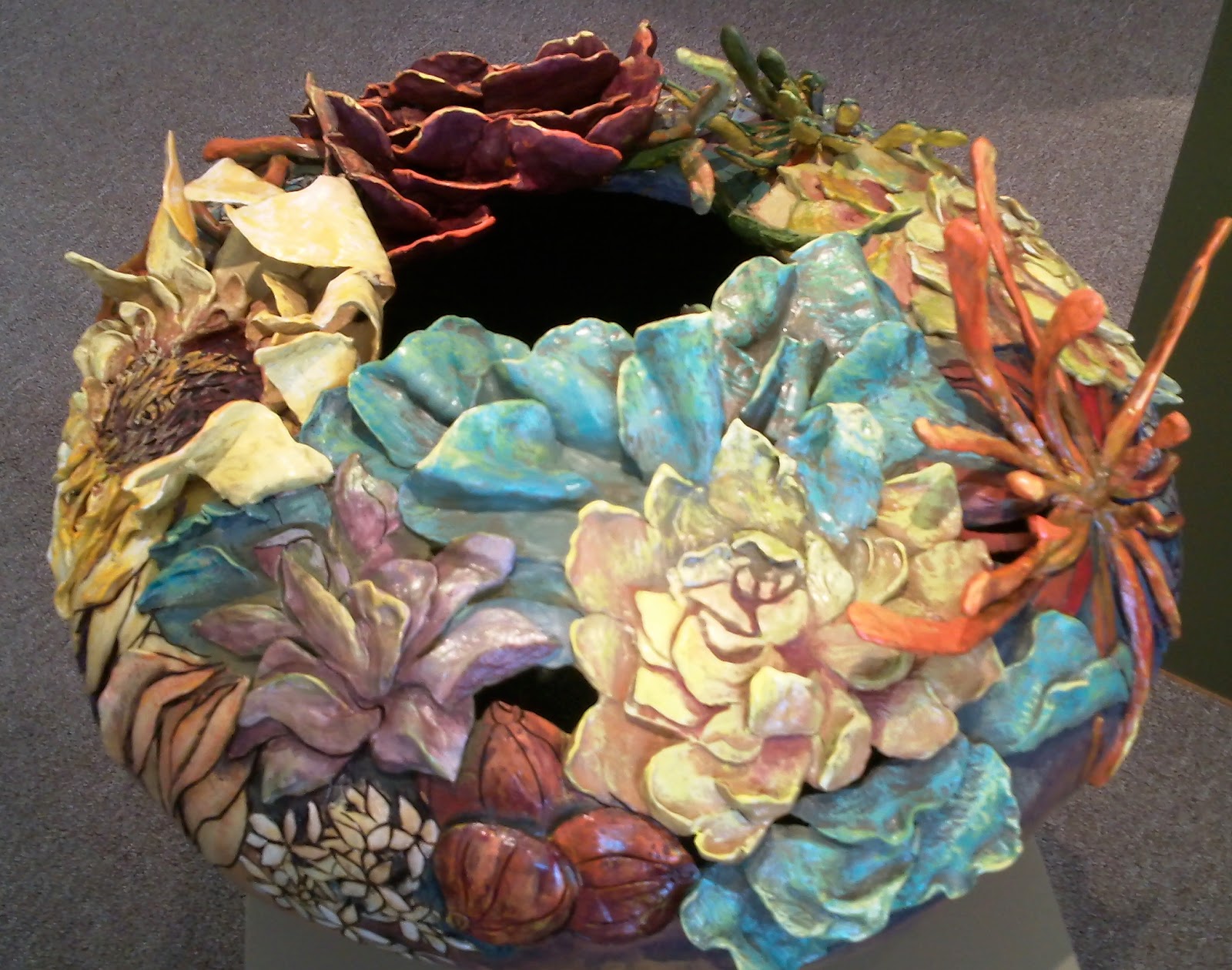
Saying goodbye to an art work that I worked hard on and which rose to the top of my expectations of the piece, is a wonderful feeling.  It's really a successful communication - a conversation between the artist and the viewer (and in this case, the buyer) in the form of the art - and that process is a sort of art in and of itself, if that makes sense.  It all feels like a completed full circle when the art finds its "person".  And so, here are three views of Succulents & Sunflower which met, and went home with, its person today.


And tomorrow I'll say hello to the beginnings of a new piece - Poppies in the Grass.....


Saturday, January 15, 2011

Just the Beginning...

Good Morning Everyone, and a gorgeous morning it is here in Scottsdale, AZ!  The Celebration of Fine Art opened its doors last night for the opening night party and, though all the artists were breathing hard from the four days of fourteen hours constructing their studios and getting their work hung, the guests seemed only to marvel at the result (and enjoy the delectable offerings of Cafe Laredo).  Seeing old friends/clients who are always interested to see each artist's new work is food for the artists, and the appreciation feels like a real pat on the back for the efforts we make.

I hope to do something a bit different this year with my blog, posting each day about what's happening at the show, but particularly to acquaint you with our artists.  This is my fourteenth year at the show and I have seen so much remarkable work that I wish I had told more people about - now I have this great vehicle to do so.

For now, I'm off to our first official day and to shoot some pics for an overview to share with you tonight!

Sunday, November 14, 2010

The Pace of Mindfulness

I have lately become a fan of Daisy Hickman's blog, Sunny Room Studio.  Today she was reflecting on writing by Buddhist teacher, Thich Nhat Hanh who wrote,
     "Our habit energy is what causes us to repeat the same behavior thousands of times... The practice of mindfulness helps us to recognize that habitual energy.  Every time we can recognize the habit energy in us, we are able to stop and to enjoy the present moment.  The energy of mindfulness is the best energy to help us embrace our habit energy and transform it. The energy of mindfulness is the full awareness of the present moment...The energy of mindfulness carries within itself the energy of concentration.  When you are mindful of something, whether that something is a flower, a friend, a cup of tea, you become concentrated on the object of your mindfulness.  The more you are mindful, the more concentrated you become.  The energy of concentration is born from the energy of mindfulness.  And if you are concentrated enough, the energy of concentration contains the energy of insight.  Mindfulness, concentration, and insight are the energies that make up the Buddha."


Ms Hickman went on to say,  "A superficial life is much like an “unexamined life,” a sequence of events without meaning or purpose. Or understanding."


My studio is very sunny and quiet today, Sunday.  There is no music, or sound other than an occasional bird or muffled road noise from a passing car.  I am at work on an intricate gourd and, at the moment, the sculpture medium needs some drying time.  For a while I can drift in the topic of mindfulness.  


There is something acutely near my mind that I cannot quite grasp.  This sensation surfaces frequently when I am in the midst of my work.  The creative process is one of great concentration, or mindfulness, when one is fully engaged.  Some would call it focus.  Others might define it  in more religious terms as in God speaking to me.  I am neither a very scientific, nor a very religious person, so those analogies don't quite work for me.  Nor am I of a meditative nature.  My mind is not easy to quiet.  One of the most difficult things about being an artist is turning the generative mind off - sleep eludes me, and when it does come, it often arrives with much dream activity, sometimes solving problems, often giving the gift of wholly finished works which I must try to capture in my conscious mind in the instant of waking, lest they slip away.  But, I do like to ponder.  


Buddhist thought is often expressed in simplistic terms and becomes trivialized as greeting card adages.  An example of this was in vogue several years ago when everyone was spouting "you create your own reality," and much sadness transpired as folks with major illnesses came to believe that somehow they had created their illnesses, and parents dealing with the death of a child were shamed into believeing they were to blame for their tragic circumstances.  Too simplistic.  Not incorrect, perhaps, in certain deeper implications, but far too simple to be left unexamined.  Life is not a greeting card.  Why are we always looking for the simple, the easy, the quick in everything that we do?  


Ms. Hickman went on to say,  "A superficial life is much like an “unexamined life,” a sequence of events without meaning or purpose. Or understanding."  I agree with this, knowing that I have many superficial moments - after all, how deep is the moment I spend plucking my eyebrows or making certain my dishes don't have water stains on them?  We could talk about levels of superficiality here, but let's not.  Pick up People magazine for that.  But I do think that some pondering on the Buddhist Mindfulness-Concentration-Insight path is worth some time.
  
The link that Mr. Hanh makes is mightily important, because it points to growth, and by extension, change.  Ms. Hickman's "sequence of events" may coincide with a certain level of mindfulness (think focusing, visualizing that new car, winning lottery ticket, check-in-the-mail from nowhere).  But is there meaning or purpose beyond the simplistic car, ticket, check?  Does the mindfulness of the self (or self-desired object) lead to Mr. Hanh's "concentration?"  He says, "The more you are mindful, the more concentrated you become.  The energy of concentration is born from the energy of mindfulness."  So, when we are disappointed that the car doesn't materialize, do we recognize that we have not fully enrolled ourselves in the mindfulness of the car, to the point of concentration?  Probably not.  We, most likely, are like a child who wants what he wants now, until he wants something else in the very next moment.  Which leads to the question of what happens in the state of "mindfulness?"  Turns out that perhaps mindfulness is not so easy after all, nor simple.  I'm pretty certain that anyone reading this who has been practicing mindfulness for very long, is having difficulty staying in the moment, without clicking to another blog.  Yes, I say yes, not so easy.  Not simple.  How many things snag your consciousness when you are focusing on mindfulness of breathing? Please!  I know I've already copped to not meditating.  So what is there for us less disciplined folk, we who feel our stomach rumble in the middle of the out breath, who have to scratch the itch impeding our in breath, whose every aching joint and muscle scream for our attention while we sit cramped in the impossible lotus? 

There is this: slowing down.  That's all.  Just slowing down.  Try this: get three clocks- one with no second hand, one with a second hand, and one digital (stop watch) counting one-hundredths of a second.  Sit down with them, one at a time, and be mindful, or concentrate on one specific thing for two minutes.  Be mindful of how well you can do this in each given time sequence.  This is not rocket science, because, as I mentioned, I am not of a scientific bent.  It is, however, pretty obvious.  Given the slower pace of the clock with no second hand, your mind quiets itself, able to readjust it's thought even if it wanders.  It wanders, if you will, at a slower pace.  I think that perhaps what Mr. Hanh is telling us is to slow down.  Being in the moment is not equivalent to jumping into the moment.  It is slowing down your eternal forward motion enough so that the moment, the elusive moment, can envelope you.  The moment isn't stationary.  It isn't a stop in time.  The moment is moving forward also.  But, if one is able to slow down, become enveloped in the moment, that act will take you to a different place than you would otherwise have arrived at.  And that is the insight.  That by slowing down, we can change what we are consciously aware of; we can alter our moment, and in that altered moment, or altered consciousness, something may open for us.  An insight. An understanding.

"A superficial life is much like an “unexamined life,” a sequence of events without meaning or purpose. Or understanding."  A superficial life, then, is a life in which we, without consciousness, allow ourselves to be propelled by the ever increasing speed of the Universe, without pausing to experience our own being.