Happy anniversary. People say it every day, I suppose. An anniversary - something memorable - a time to be marked, to be celebrated, to be counted as a measure of commitment or love or perseverance. And sometimes it's a measure of strength and survival.
I have friends who celebrate their wedding anniversaries with much symbolism, sometimes elaborate gifts and surprises, trips, jewelry, getaways at romantic places, and some ways which are too private to disclose. I wonder what that means. Is it like a birthday? A cultural event? An occasion for gift giving and getting? Is it sometimes inspired but often merely the habit to do the socially prescribed?
I don't know the answer to these questions because Syed and I have almost never celebrated our wedding anniversary in the usual ways. We've been married for almost 23 years. We work and play together and always have. We travel happily, laugh a lot, love many of the same things, and are what any psychologist would call "happily married." So, why do we not celebrate our anniversary?
We used to laugh at ourselves and how weird we were to have forgotten, only to be reminded by our friend, Frank, who "gave me away", when he would unfailingly call to wish us the "Happy Anniversary!" that we had let slip by. Early on, I would wonder what our forgetfulness really meant. There must be some reason, some psychologically imperative reason, because, after all, didn't everyone who was happily married remember their anniversary for pete's sake?
Every spring, in March, I silently "celebrate" an anniversary. One I never forget though it never appears on my calendar. It is an anniversary that resides in my bone marrow. In my heart. In my soul. In the pit of my gut from which the memory rose, in the early years, in a kind of bile, threatening to swamp me, bursting out of my body in sweat and shaking and voiceless sobs. As the anniversaries passed of my mother's death, when I was fifteen, the joyous Springs of chubby hyacinths, pregnant with sunburst perfume, of daffodils and tulips shouting candy reds and yellows against the last whites of winter passed me by. So lost was I in the anguish of not being able to bring forth her face, the pain of waking from the dream of her voice, that Spring was a lingering dark void.
An anniversary, not happy - but a remembrance, a marking. Even now, fifty-three years later, an undeniable seasonal sadness flutters on my shoulders. It no longer settles there. Life, if one chooses it, actually chooses it in all it's vagaries and surprises, brings gifts of allowance - allowance for others to choose their own path, allowance for sadness as well as happiness, allowance for anger to pass and something like grace to enter in, allowance for pain and for loss. And then, Life brings you the balance of itself. It brings you views of horizons you didn't know were there, opportunities to love, to imagine, and then to create.
This Spring, the remembrance of the time of my Mother's passing will be somehow sweetened, imagining her at my shoulder as I greet my newest grandbaby. Quietly I will say, Mom, here we all are - we have survived, we love, we choose Life. Know that we love you.
And my wedding anniversaries? I think that Syed and I don't mark them on a certain day because our days pass lovingly, filled with simple happiness, long philosophical talks, good music, comfortable silences, lots of laughter, busy creativity. No trauma jars my memory of these nearly 23 years. I choose him each day and believe he chooses me each day. No need to send a card.
Thank you, Daisy, for your blog at http://bit.ly/evQGg7. May your silent time be filled with grace.
Wednesday, February 9, 2011


Sunday, January 30, 2011
Thursday, January 27, 2011
Distinguishing Value/Original vs. Reproductions
NOTE: I'm posting this piece again because it doesn't appear in my stats. Anyone reading it?
Following up on a comment left on my last post by Liana, let's continue the conversation about price and value of an art work. Liana injects the subject of original work versus reproduction, so let's start with a couple of artists, Griselda, who sells only original (one-of-a-kind) work, and her sister, Prunella, who sells reproductions of her originals. For argument's sake, let's give them the benefit of the doubt and say that they are regarded equally in the art world, both sought after and collected. Let's also paint them as on equal financial footing in regards to their work.
So, what is the difference in actual value of the work, in perceived value, and in the mystical "Vision" value, which I suggested in the last post.
Is the "actual value" the price set or the price paid? Does "perceived value" affect "actual value" (of either type)? How does the "vision value" affect actual and/or perceived value? Hmmmm. I sense a snake pit.
I see Griselda coming from her studio now. Gris, I know you've considered these questions over the years. Could you give us some insight based on your personal experience?
Sure, Whitney. I've been painting for a couple of decades. Painting is both my job and my love. It excites me to think and work in new and fresh ways, and, for me, painting versions of the same piece is not satisfying, and ultimately is not stimulating for my clients. So, I sell only my original work.
Yes, I can understand that feeling of excitement about new work, but, Gris, you do a lot of work. Do you mean to say that each and every painting is a new idea? How can you keep up your output if every piece has to be an absolutely new idea? And what about the stress of selling those expensive pieces, when reproductions can be sold for much less and with little effort on your part?
Perhaps we need to talk about what "original" means. If I paint a particularly exciting piece - a piece that, in the process of painting, generates several more ideas, I go with it, and it becomes a series, perhaps following a theme or a color palette or form, but each one furthering the original thought. This series may be, for example, about movement. To the viewer, it may appear to be the "same" painting done over and over with very small changes. To the artist, it may be movement itself. You paint, Whitney. How many paintings could you do about "red"? Would the viewer say, good grief, does she ever paint anything else?
OK, I get it. But, what about the issue of money and the increased income you would, or could, have if you sold reproductions of your work?
Mmmm. Another bird altogether. First, I am fortunate that I don't have to make any more money than I already do. My financial needs aren't great. If they were, perhaps I would consider selling prints. Until then, I believe that reproducing my work lessens the value of all original work, not just my own. Philosophically, I believe it is better to buy bad original work than to buy a reproduction of the best painting ever done. Art, in its purest form, is a communication between artist and viewer. A reproduction, no matter how skillfully marketed, is nothing more than a facsimile, an impersonation of that. In effect, it is a counterfeit, an ersatz conversation with the artist. The subtleties of experience, which Liana mentioned, cannot exist other than in the original piece. Here comes Prunella. She thinks quite differently than I. Pru! Come give us your insights as an artist.
Prunella, what's your view on selling reproductions of your work?
I sell a lot of reproductions. Some are good. Some less good. But I have a huge audience because of the affordability of prints. I believe my work is good. It has been validated in the appropriate circles. I have collectors who buy my originals. And, because I sell reproductions well, I can actually have time to do something other than paint. I like to swim and hike, play a little golf. Unlike Gris, I think it's important to get good art out to as big an audience as possible. That way, there is good contemporary work available to look at, right beside the ubiquitous Monets and Picassos. And, if the artist is in the very early stages of a career, reproductions can gain an audience much quicker then if he sells only his originals.
It seems, then, that we are facing a wide philosophical gap. How is the audience of potential buyers to make an informed decision? Obviously, there are as many answers as snakes in that pit, and some of them are just as slimy.
Many have experienced the fallacious marketing of print editions of 10-20 years ago. People were duped into buying prints from "limited" editions of 5000, and sometimes that meant 5000 in each size offered of the same print! Then the naive buyer would try to sell his "limited edition" print only to find it had no value at all. Very sad. Very bad! For the buyer, and for all artists doing reproductions, be they honorable or not. Next came the early giclees, many of which had terrible integrity of material, fading almost immediately. After that, prints were touted with the "artist enhanced" moniker.
Time passed. Giclee printing improved. Texturing became possible. The quality of reproductions has gone sky high. Marketing them is an art in itself. But, in the end, the buyer must remember that it is still only a reproduction of the original painting. The value to the buyer must be that he is able to own something done by his favorite artist that he would otherwise not have been able to afford. The current reproductions are not hand pulled lithographs, or monographs, or true limited editions (usually not more than 25). They are facsimiles - likenesses of the original.
I have absolutely no objection, either philosophically or commercially, to selling reproductions. I do categorically object to implying to a potential buyer that this reproduction is, in any way, an original. Hedging words is misleading, and in a world of false and misleading advertising, we owe it to our clients, whether they spend $100 or $100,000, to be crystal clear about what they are buying. A client may indeed be thrilled with the fact that you have reproduced his $20,000 painting so that he can say, "I have the original!" But would that client be so thrilled to hear that his secretary bought "an original hand embellished limited edition" version of the same painting for $100? Perhaps not.
In the end, it is an issue of personal ethics and communication. These are large concepts coloring every part of our lives as artists, parents, teachers, employers and employees, mates and partners, medical professionals and politicians. We have only limited opportunities to consciously confront them in an academic way - a way in which we might better understand what ethics are and how to communicate. It is up to us, individually, to continually ask ourselves the important questions - to not simply fall in line with the current market fashions of white lies and partial truths. It is up to us, individually, to embark on civil discourse about matters which affect us all. Through the discourse, we achieve clarity - even if we only become clear about that which is unclear!
And, by the way, thanks to my fictitious friends, Griselda and Prunella, for joining us.
Following up on a comment left on my last post by Liana, let's continue the conversation about price and value of an art work. Liana injects the subject of original work versus reproduction, so let's start with a couple of artists, Griselda, who sells only original (one-of-a-kind) work, and her sister, Prunella, who sells reproductions of her originals. For argument's sake, let's give them the benefit of the doubt and say that they are regarded equally in the art world, both sought after and collected. Let's also paint them as on equal financial footing in regards to their work.
So, what is the difference in actual value of the work, in perceived value, and in the mystical "Vision" value, which I suggested in the last post.
Is the "actual value" the price set or the price paid? Does "perceived value" affect "actual value" (of either type)? How does the "vision value" affect actual and/or perceived value? Hmmmm. I sense a snake pit.
I see Griselda coming from her studio now. Gris, I know you've considered these questions over the years. Could you give us some insight based on your personal experience?
Sure, Whitney. I've been painting for a couple of decades. Painting is both my job and my love. It excites me to think and work in new and fresh ways, and, for me, painting versions of the same piece is not satisfying, and ultimately is not stimulating for my clients. So, I sell only my original work.
Yes, I can understand that feeling of excitement about new work, but, Gris, you do a lot of work. Do you mean to say that each and every painting is a new idea? How can you keep up your output if every piece has to be an absolutely new idea? And what about the stress of selling those expensive pieces, when reproductions can be sold for much less and with little effort on your part?
Perhaps we need to talk about what "original" means. If I paint a particularly exciting piece - a piece that, in the process of painting, generates several more ideas, I go with it, and it becomes a series, perhaps following a theme or a color palette or form, but each one furthering the original thought. This series may be, for example, about movement. To the viewer, it may appear to be the "same" painting done over and over with very small changes. To the artist, it may be movement itself. You paint, Whitney. How many paintings could you do about "red"? Would the viewer say, good grief, does she ever paint anything else?
OK, I get it. But, what about the issue of money and the increased income you would, or could, have if you sold reproductions of your work?
Mmmm. Another bird altogether. First, I am fortunate that I don't have to make any more money than I already do. My financial needs aren't great. If they were, perhaps I would consider selling prints. Until then, I believe that reproducing my work lessens the value of all original work, not just my own. Philosophically, I believe it is better to buy bad original work than to buy a reproduction of the best painting ever done. Art, in its purest form, is a communication between artist and viewer. A reproduction, no matter how skillfully marketed, is nothing more than a facsimile, an impersonation of that. In effect, it is a counterfeit, an ersatz conversation with the artist. The subtleties of experience, which Liana mentioned, cannot exist other than in the original piece. Here comes Prunella. She thinks quite differently than I. Pru! Come give us your insights as an artist.
Prunella, what's your view on selling reproductions of your work?
I sell a lot of reproductions. Some are good. Some less good. But I have a huge audience because of the affordability of prints. I believe my work is good. It has been validated in the appropriate circles. I have collectors who buy my originals. And, because I sell reproductions well, I can actually have time to do something other than paint. I like to swim and hike, play a little golf. Unlike Gris, I think it's important to get good art out to as big an audience as possible. That way, there is good contemporary work available to look at, right beside the ubiquitous Monets and Picassos. And, if the artist is in the very early stages of a career, reproductions can gain an audience much quicker then if he sells only his originals.
It seems, then, that we are facing a wide philosophical gap. How is the audience of potential buyers to make an informed decision? Obviously, there are as many answers as snakes in that pit, and some of them are just as slimy.
Many have experienced the fallacious marketing of print editions of 10-20 years ago. People were duped into buying prints from "limited" editions of 5000, and sometimes that meant 5000 in each size offered of the same print! Then the naive buyer would try to sell his "limited edition" print only to find it had no value at all. Very sad. Very bad! For the buyer, and for all artists doing reproductions, be they honorable or not. Next came the early giclees, many of which had terrible integrity of material, fading almost immediately. After that, prints were touted with the "artist enhanced" moniker.
Time passed. Giclee printing improved. Texturing became possible. The quality of reproductions has gone sky high. Marketing them is an art in itself. But, in the end, the buyer must remember that it is still only a reproduction of the original painting. The value to the buyer must be that he is able to own something done by his favorite artist that he would otherwise not have been able to afford. The current reproductions are not hand pulled lithographs, or monographs, or true limited editions (usually not more than 25). They are facsimiles - likenesses of the original.
I have absolutely no objection, either philosophically or commercially, to selling reproductions. I do categorically object to implying to a potential buyer that this reproduction is, in any way, an original. Hedging words is misleading, and in a world of false and misleading advertising, we owe it to our clients, whether they spend $100 or $100,000, to be crystal clear about what they are buying. A client may indeed be thrilled with the fact that you have reproduced his $20,000 painting so that he can say, "I have the original!" But would that client be so thrilled to hear that his secretary bought "an original hand embellished limited edition" version of the same painting for $100? Perhaps not.
In the end, it is an issue of personal ethics and communication. These are large concepts coloring every part of our lives as artists, parents, teachers, employers and employees, mates and partners, medical professionals and politicians. We have only limited opportunities to consciously confront them in an academic way - a way in which we might better understand what ethics are and how to communicate. It is up to us, individually, to continually ask ourselves the important questions - to not simply fall in line with the current market fashions of white lies and partial truths. It is up to us, individually, to embark on civil discourse about matters which affect us all. Through the discourse, we achieve clarity - even if we only become clear about that which is unclear!
And, by the way, thanks to my fictitious friends, Griselda and Prunella, for joining us.
Monday, January 24, 2011
Pricing Artwork/Thinking, Making, Marketing+Vision
It has always felt like an oxymoron to fuse money and creativity into one word - price. As in, "What is the price of your painting?" What is the price of an artist's work, how is it determined, what factors does it include, is it fair, and above all, what does it mean? What does it mean to the audience? What does it mean to the artist?
Let's try to sort this out.
Selling art isn't any different than selling widgets. Or is it? Art is not a manufactured good - not plastic bowls or wood screws or tubes of toothpaste. Art is, for discussion purposes here, one something envisioned, made and brought to market by one person. Often the source materials are made or harvested by that same person. The advertising and shipping done by that person. How is that time tracked and costed out so as to make sense for the artist doing all this work? How does one person, who is also the administrative assistant, schedule and account for such a varied work load? And how does one price materials used in the work which might be irreplaceable, necessitating a new design approach for the next work? What about accounting for materials which, in and of themselves, take additional time to ready for use, such as the painter who mixes his/her own pigments or the jeweler who also cuts his/her own stones? These are some of the factors that most art buyers aren't even aware of when they come to the studio or look at a painting or sculpture, pot or bracelet, custom made jacket or assemblage of hand made papers. The art is what they come to see, and it is usually all they see. Art bears its own ambiance. No artist wishing to sell his/her work would bore a client with the nuts and bolts of their business.
And what of the time it takes to think through the vision of the work before it ever comes to production? Time sketching could be assigned a specific value. What about time thinking? Artists hear, over and over, "That's amazing! How do you even come up with these ideas?" The answer is, that's how artist's think. Speaking personally, for myself, I see things very clearly in my mind's eye, but that doesn't happen in a flash. I think about something until it makes itself into a clear visual in my mind. Only then am I ready to manifest it in clay or paint. What is the assigned value of that thinking? Only the artist can assign that value and assign it he/she must, even in just the very broadest sense, because the thinking is the first of the three major components of pricing artwork. Thinking. Making. Marketing. I intentionally do not use the word "creating" because I believe too many people have creating conflated with making.
The making of a work of art is the easiest part to keep track of. Many artists work a consistent number of hours a day. But when a client asks "How long did it take you to make that?", the question must be understood to mean more than just the time the potter spends at the wheel and the glazing pot. It must include the thinking and the marketing as well. And the artist's responsibility is to explain to the uninitiated client the three factors included in bringing this gorgeous, unique pot to this pedestal in this studio at this moment in time.
Assigning value to marketing is the most difficult of all. It is also inclusive of the widest range of variables - documenting photographs, show application fees, show display fees, travel and accommodation to shows, vehicle/trailer expenses, advertising (print ads, business cards & stationary, videos, brochures), business fees & licenses, exhibition booths (tents, walls, pedestals, lighting, flooring),
and the time spent getting to, being at, and returning from shows (because this is time that is not spent in the studio producing).
Ask any business man and my bet is that he will tell you all of this plus more that I've either failed to recognize or note! But how many people looking at that lyrical painting or simple, perfect stone sculpture will think of these things when they look at the price?
These days we've all become accustomed to discounted prices before the goods have barely hit the shelves. Can the buyer be blamed for asking, "Is that your best price?" Perhaps not. But if it offends the artist, then they bear the responsibility of saying, "Yes, it is" or be prepared to bargain. Being prepared to bargain means that the artist must know what the price on the work means to him, and be confident in that meaning.
So, what then, beyond the Thinking, Making, and Marketing, affects the price of an artwork? What is the single thing that makes this worth more than that?
To me, as an artist, it is the Vision and how close the work comes to that Vision. And that equals meaning for me. When I create a piece which meets the expectations I have when I begin to make my Vision manifest, I have succeeded by all measure of the word. That success carries value and that value is not negotiable.
What does price mean to you as a buyer? As an artist?
Let's try to sort this out.
Selling art isn't any different than selling widgets. Or is it? Art is not a manufactured good - not plastic bowls or wood screws or tubes of toothpaste. Art is, for discussion purposes here, one something envisioned, made and brought to market by one person. Often the source materials are made or harvested by that same person. The advertising and shipping done by that person. How is that time tracked and costed out so as to make sense for the artist doing all this work? How does one person, who is also the administrative assistant, schedule and account for such a varied work load? And how does one price materials used in the work which might be irreplaceable, necessitating a new design approach for the next work? What about accounting for materials which, in and of themselves, take additional time to ready for use, such as the painter who mixes his/her own pigments or the jeweler who also cuts his/her own stones? These are some of the factors that most art buyers aren't even aware of when they come to the studio or look at a painting or sculpture, pot or bracelet, custom made jacket or assemblage of hand made papers. The art is what they come to see, and it is usually all they see. Art bears its own ambiance. No artist wishing to sell his/her work would bore a client with the nuts and bolts of their business.
And what of the time it takes to think through the vision of the work before it ever comes to production? Time sketching could be assigned a specific value. What about time thinking? Artists hear, over and over, "That's amazing! How do you even come up with these ideas?" The answer is, that's how artist's think. Speaking personally, for myself, I see things very clearly in my mind's eye, but that doesn't happen in a flash. I think about something until it makes itself into a clear visual in my mind. Only then am I ready to manifest it in clay or paint. What is the assigned value of that thinking? Only the artist can assign that value and assign it he/she must, even in just the very broadest sense, because the thinking is the first of the three major components of pricing artwork. Thinking. Making. Marketing. I intentionally do not use the word "creating" because I believe too many people have creating conflated with making.
The making of a work of art is the easiest part to keep track of. Many artists work a consistent number of hours a day. But when a client asks "How long did it take you to make that?", the question must be understood to mean more than just the time the potter spends at the wheel and the glazing pot. It must include the thinking and the marketing as well. And the artist's responsibility is to explain to the uninitiated client the three factors included in bringing this gorgeous, unique pot to this pedestal in this studio at this moment in time.
Assigning value to marketing is the most difficult of all. It is also inclusive of the widest range of variables - documenting photographs, show application fees, show display fees, travel and accommodation to shows, vehicle/trailer expenses, advertising (print ads, business cards & stationary, videos, brochures), business fees & licenses, exhibition booths (tents, walls, pedestals, lighting, flooring),
and the time spent getting to, being at, and returning from shows (because this is time that is not spent in the studio producing).
Ask any business man and my bet is that he will tell you all of this plus more that I've either failed to recognize or note! But how many people looking at that lyrical painting or simple, perfect stone sculpture will think of these things when they look at the price?
These days we've all become accustomed to discounted prices before the goods have barely hit the shelves. Can the buyer be blamed for asking, "Is that your best price?" Perhaps not. But if it offends the artist, then they bear the responsibility of saying, "Yes, it is" or be prepared to bargain. Being prepared to bargain means that the artist must know what the price on the work means to him, and be confident in that meaning.
So, what then, beyond the Thinking, Making, and Marketing, affects the price of an artwork? What is the single thing that makes this worth more than that?
To me, as an artist, it is the Vision and how close the work comes to that Vision. And that equals meaning for me. When I create a piece which meets the expectations I have when I begin to make my Vision manifest, I have succeeded by all measure of the word. That success carries value and that value is not negotiable.
What does price mean to you as a buyer? As an artist?
Saturday, January 22, 2011
Art and Sales at the Celebration of Fine Art
Congratulations to Donna Bernstein on the sale of her large diptych!

And now, let me introduce a fellow artist, Mark Carroll, sculptor of metals, stone, wood, and whatever else he has in his hands! Mark began the Celebration of Fine Art while living in Buffalo, NY, so is it any surprise that he now lives full time in AZ? His powerful stone and metal combinations would enhance both traditional as well as contemporary surroundings. Head to the NW corner of the tent and you will pass through Mark's studio. His work is both inside the tent and out in the courtyard.


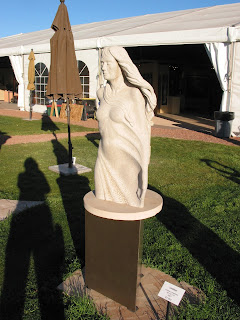

And now, let me introduce a fellow artist, Mark Carroll, sculptor of metals, stone, wood, and whatever else he has in his hands! Mark began the Celebration of Fine Art while living in Buffalo, NY, so is it any surprise that he now lives full time in AZ? His powerful stone and metal combinations would enhance both traditional as well as contemporary surroundings. Head to the NW corner of the tent and you will pass through Mark's studio. His work is both inside the tent and out in the courtyard.


Succulents & Sunflower
Saying goodbye to an art work that I worked hard on and which rose to the top of my expectations of the piece, is a wonderful feeling. It's really a successful communication - a conversation between the artist and the viewer (and in this case, the buyer) in the form of the art - and that process is a sort of art in and of itself, if that makes sense. It all feels like a completed full circle when the art finds its "person". And so, here are three views of Succulents & Sunflower which met, and went home with, its person today.


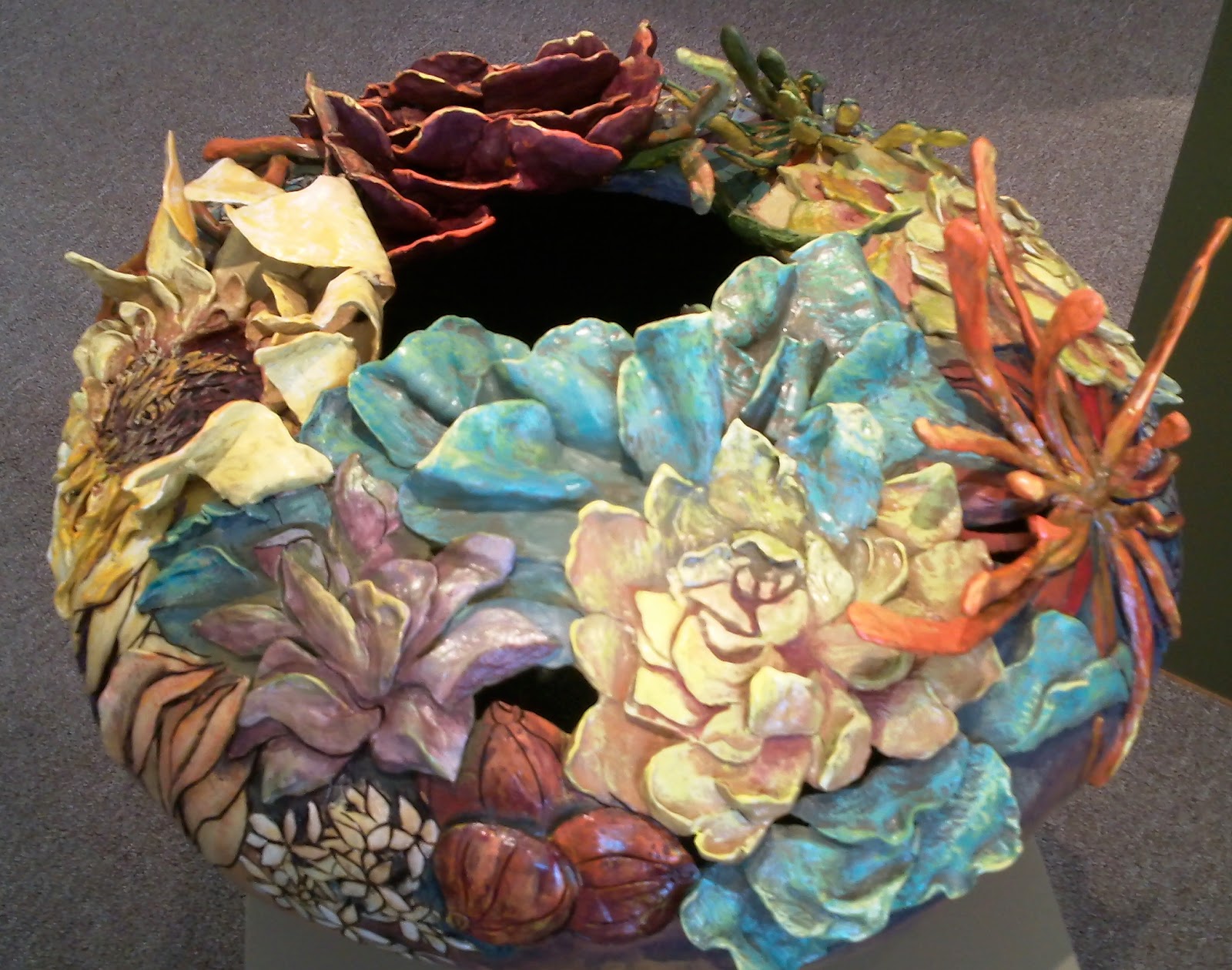
And tomorrow I'll say hello to the beginnings of a new piece - Poppies in the Grass.....

Wednesday, January 19, 2011
Diamonds & Reticulated Silver & Gold!
Come along with me as I continue featuring Celebration of Fine Art artists, art and happenings in the Big White Tent at the Loop 101 and Scottsdale Rd, here in Scottsdale, AZ where the sun is shining and the temps headed towards a delicious 74 degrees.
Donna Armstrong, in the NW Salon of the Celebration, is a jeweler and a gemologist. You'll know this as soon as you ask her about the difference between diamonds! The first shot is of a London Blue Topaz necklace and earrings set in reticulated silver and 14k gold. The London Blue is the darkest and richest in color of all the topazes. I knew the reticulated look, but what I didn't know is that it is accomplished by texturing the metal with a torch.
The second pic is a custom wedding set that Donna updated for the client, using the client's original wedding stones, but adding the center Ascher cut diamond for a beautiful contemporary design with a nod to the traditional band. Characteristic of the Ascher cut is the square stone with the corners cut off.


Donna Armstrong, in the NW Salon of the Celebration, is a jeweler and a gemologist. You'll know this as soon as you ask her about the difference between diamonds! The first shot is of a London Blue Topaz necklace and earrings set in reticulated silver and 14k gold. The London Blue is the darkest and richest in color of all the topazes. I knew the reticulated look, but what I didn't know is that it is accomplished by texturing the metal with a torch.
The second pic is a custom wedding set that Donna updated for the client, using the client's original wedding stones, but adding the center Ascher cut diamond for a beautiful contemporary design with a nod to the traditional band. Characteristic of the Ascher cut is the square stone with the corners cut off.

Donna, one of our Idaho artists, has been a jeweler for fifteen years and here in the NW Salon for three. She works primarily with custom pieces, so...Valentine's Day is coming up........
See you tomorrow.
Tuesday, January 18, 2011
Efflorescence and Inspiration from Poetry

Efflorescence - "a period of bloom", "a result of growth and development"- describes both the work and the artist's presence in his studio this year.

 |
| Autumn for 2011 |
This year I had more time in my studio than I usually do. This is always a gift from the Universe since I would greatly prefer to be there working than anywhere else on the planet (with children, being the only exception). Coincidentally, I knew I would have a larger studio space at the Celebration. I'm not sure I can quite describe the feeling of being lost in time and space that I get when lost in my work. It is something of grace, I think. The result is the major work this year - two large figurative pieces - and if you visit the show, I would be happy to tell you about them, as they have their own "stories", their "birth" and their "history".
| I Know Why the Caged Bird Sings/Madonna of the Sparrows |

 |
| I Know Why the Caged Bird Sings/Letters from Burma |
I had intended to introduce you today to Donna Armstrong's jewelry but I was not able to get her pictures yesterday....but check in tomorrow for simple elegance!
All text and images on this post copywrited 2011 Whitney Peckman
Subscribe to:
Posts (Atom)